When you start planning your Lucha Libre night in Mexico City, one question comes up quickly: Arena México or Arena Coliseo? Every guide gives you a version of the same answer — big arena versus small arena, loud versus intimate. That is accurate, but it is not the whole picture.
I have taken hundreds of international visitors to both venues. The right choice depends on what kind of experience you are actually looking for, and there are a few things most guides do not tell you.
The Short Answer
If this is your first time seeing Lucha Libre, go to Arena México on a Friday night. If you want something more raw, more local, and are comfortable navigating a neighborhood that feels nothing like Polanco or Roma Norte, Arena Coliseo on a Saturday is worth it.
Arena México: The Cathedral, and What That Actually Means
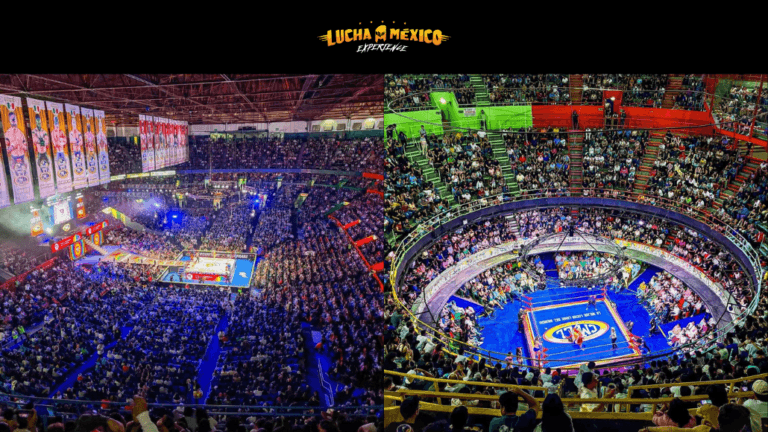
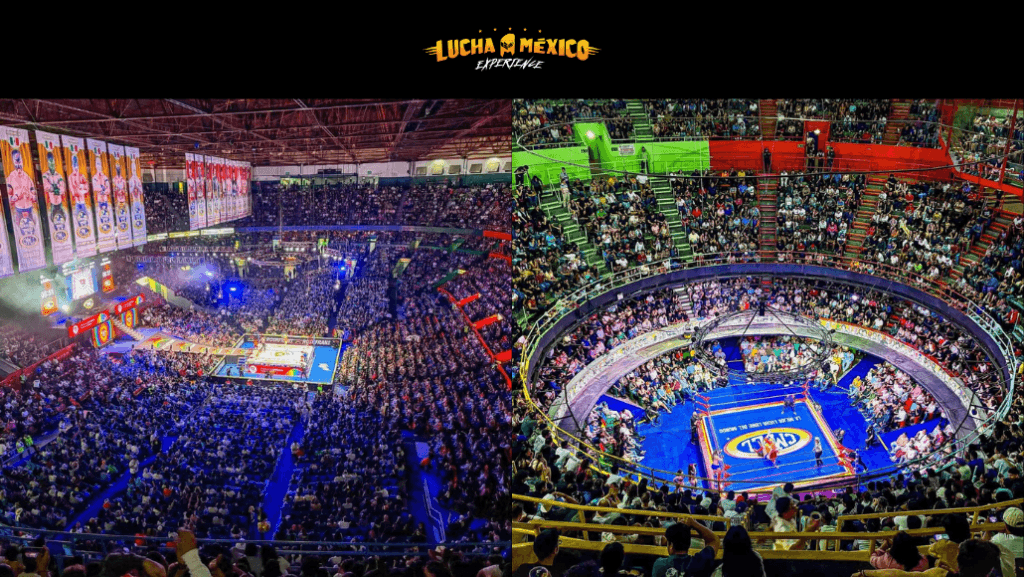
Arena México was built in 1956 specifically for Lucha Libre. It holds more than 16,500 people and hosts CMLL events on Tuesdays, Fridays, and Sundays. Locals call it La Catedral, and that name earns its weight.
Friday night is the main event. The biggest card of the week, the best production, the most electric crowd. When 10,000 people decide simultaneously to boo the rudo, you feel it in your chest before you process it with your brain. That is Arena México on a Friday.
What most first-timers do not fully understand is the geography of the seating. The ring is in the center. Ringside seats put you within arm’s reach of luchadores who occasionally spill out of the ring and into the aisles. The action is not contained. Buying cheap tickets means sitting in the upper tiers, which in a 16,000-seat arena means being genuinely far from the ring. The difference between a ringside experience and a general admission experience at Arena México is not aesthetic. It is a fundamentally different show.
Getting there is straightforward. The venue sits at the edge of Colonia Doctores, accessible via Metrobús Line 3 or Metro Line 1 at Cuauhtémoc or Balderas. From Roma Norte, a 20-minute walk is doable before the show. After the show, take an Uber.
Arena Coliseo: History With No Apologies
Arena Coliseo opened in 1943 and hosts CMLL events on Saturdays. It seats roughly 5,000 people in a circular configuration that puts every section close to the ring. There is no bad seat. There is also no escaping the noise, the smell of the crowd, or the energy of a local audience that has been coming here for decades.
This is the arena where generations of Mexico City families have watched Lucha Libre. It is in La Lagunilla, a few blocks north of Centro Histórico, in a neighborhood that is not a tourist area. That is precisely its appeal and also the main practical consideration.
The neighborhood around Arena Coliseo at night requires awareness. It is not unusually dangerous for a major Latin American city, but it is not a place to wander after the show ends. Plan your arrival and your departure. Uber in, Uber out. Do not linger.
Inside the arena, the intimacy changes everything. Luchadores are visible from every section. The crowd interaction is more intense. On a Saturday, the card typically includes a mix of younger luchadores building their careers and established names. It is a show where you can see the craft more clearly because you are closer to it.
The Key Variables When Deciding
The day of the week matters as much as the venue. Friday at Arena México is the best single Lucha Libre night in Mexico City for a first-time visitor. Tuesday at Arena México is a good show at a lower volume. Saturday at Arena Coliseo is an authentic, local-crowd experience. Sunday at Arena México is the family show, with an earlier start time and a different atmosphere.
Seating matters more than most people anticipate. The difference in experience between a ringside seat and an upper section is significant at Arena México in particular. If you are going once, the seat is worth the investment.
The neighborhood context matters if you are navigating on your own. Both arenas are in working-class neighborhoods where common sense applies. Neither is in the tourist corridor. That is part of the experience, not a problem to solve, but it helps to know in advance.
What a Guide Gives You That a Ticket Does Not
A ticket gets you into the arena. A bilingual guide gets you inside the show. Understanding who is the técnico and who is the rudo, knowing which luchador has a rivalry with the one climbing into the ring right now, understanding why the crowd suddenly erupts in a way that makes no sense if you are watching cold — that context is the difference between watching something and experiencing it.
That is the case at both arenas. Lucha Mexico Experience operates at Arena México on Tuesdays and Fridays and at Arena Coliseo on Saturdays, which means we match the night to the group.
The Honest Recommendation
Arena México, Friday night, ringside. That is the version of Lucha Libre that converts skeptics into lifelong fans. It is also the hardest version to pull off on your own if you do not know the venue, the ticketing, or the sport.
Arena Coliseo on a Saturday is for visitors who have already seen one show and want to go deeper, or for those who specifically want the more intimate, less touristic version from the start. It rewards curiosity.
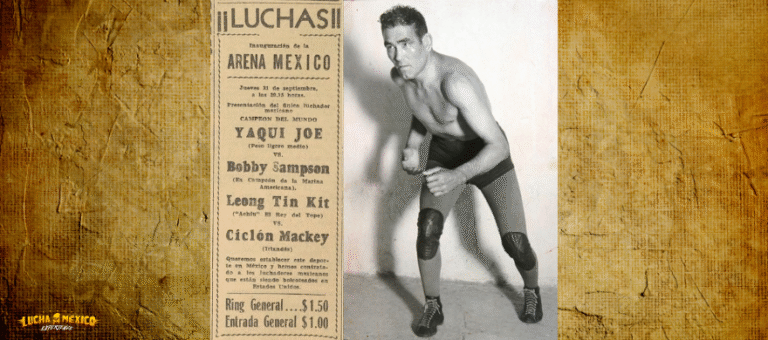
Both arenas are the real thing. The CMLL is the oldest professional wrestling promotion still operating in the world, founded in 1933. Every show at both venues is a continuation of a tradition that is nearly a century old. That is worth choosing carefully.
Ready to book? Lucha Mexico Experience includes ringside seats, a bilingual guide, tacos at Taquería El Caifán, and transport by Metrobús. Reserve your spot here.